“Smarter” is an easy word for a billing company to say and a hard one for a practice to check. Where it does show up — visibly, every month — is in reporting: what your revenue cycle management partner sends you, what you can look at without asking, and what happens to the questions those numbers raise.
Plenty of practices outsourced billing and lost sight of their own revenue in the process. Once a month a summary arrives showing a total collected. If the total looks low, there is no easy way to tell whether the cause was volume, one payer slowing down, a denial pattern building quietly, or balances simply getting older. That is not a reporting problem in the narrow sense. It is a governance problem: nobody has agreed, in advance, what the practice will see, how often, and what will be decided from it.
This article sets out that agreement: the report package to expect, the difference between direct access and a month-end summary, how a monthly revenue review should run, and the decisions good revenue cycle reporting makes possible.
Visibility is a cadence, not a document
A single report, however detailed, is a snapshot. Visibility is a rhythm: a complete package at month-end, a meeting where it is explained and decisions are recorded, and a check the following month on whether those decisions happened and worked.
That rhythm matters because revenue problems are usually slow. A payer that starts taking longer to pay does not announce itself. Balances drift from one aging bucket to the next a week at a time. A denial reason that appeared twice in March appears twelve times in May. These are only visible to someone looking at the same views, in the same order, every month — when the format stays stable, a change in the numbers stands out instead of hiding inside a new layout.
Fastora’s analytics and reporting service is built around that kind of recurring reporting and review. What follows is how to judge reporting like it — ours or anyone’s.
The report package a practice should receive
A useful monthly package is not one long export. It is a small set of views, each answering a different question, each comparable with the month before.
Charges, payments, and adjustments
The first view answers the simplest question: what did we bill, what came in, and what was written off — and why? Charges, payments, and adjustments belong on the same page because each changes the meaning of the others. Adjustments deserve particular attention: a growing total can reflect normal contractual write-offs, or it can hide underpayments accepted without question. Ask for adjustments grouped by type, and expect anything unusual to be explained in the review rather than discovered by you later.
Denial reasons, not just denial counts
A denial total tells you there is a problem. Denial reasons tell you where it started. The monthly view should group denials by reason — eligibility, authorization, coding and documentation, missing information, timely filing — show how each group moved, and show what is being done: which are corrected and resubmitted, which are under appeal, and which upstream step is being changed so the same denial stops recurring. A partner that reports denials without follow-up status is reporting half the story.
A/R aging, with movement explained
The aging view shows unpaid balances by how long they have been outstanding. What matters most in the review is not only the total — it is the movement: how much aged into the older buckets, how much was collected or resolved out of them, and which specific large or old balances are being worked and how. An aging report that looks similar each month while the older buckets quietly grow is a warning sign, and a good review names it directly.
Payer-level and provider-level views
Practice-level totals conceal as much as they reveal, so the package should break the same information down in two directions. The payer-level view shows which payers pay slowly, deny most often and for what reasons, and pay below what your contract leads you to expect. The provider-level view shows charges and collections by provider, surfacing differences in documentation, coding patterns, or payer mix that a combined total averages away. Neither view is about blame. Both aim the next month’s work: a problem concentrated in one payer or one provider needs a different response from one spread evenly across the practice.
Direct access versus the month-end summary
Ask any RCM partner directly: what can we see ourselves, between reports, without requesting it?
A month-end summary alone means the practice is blind for the weeks in between, and dependent on the partner’s account of its own work. Direct access — to dashboards and to the underlying information in your own practice management system — changes the relationship. Your administrator can check whether a particular claim has been submitted, look at aging before a partner meeting instead of after it, and confirm that a fix discussed last month appears in this month’s activity.
Access also disciplines the reporting itself: numbers a client can check tend to be numbers kept carefully. Treat the access question as a transparency test. The reporting in the full revenue cycle management service should reconcile with what you can see in your own system, because both come from the same data. If a partner’s reports cannot be tied back to your system, ask why before you sign.
None of this means the practice should do the analysis itself — the partner does the interpreting. Access is the safeguard underneath: you can verify when you want to, which is most valuable when something does not look right.
The monthly revenue review: a decision meeting, not a recital
The monthly review is where reporting becomes governance. Run well, it is a short, structured meeting with a standing agenda. Run badly, it is someone reading the report aloud.
A working agenda looks like this:
- Last month’s decisions first. What was agreed, who owned it, and what happened? A fix that was promised and quietly dropped should surface here, at the start.
- The month in a few numbers. Charges, payments, and adjustments; denial reasons that moved; aging movement. The point is change — what is different, and what explains it.
- Exceptions, not everything. The specific payer, provider, or claim groups that need a decision: a payer to escalate, a documentation pattern to raise with one clinician, old balances that need a policy call.
- Decisions, recorded. Each decision gets an owner and a date, in a short record both sides keep. “We are watching it” is not a decision; “the practice will send the revised intake form by the 15th, and eligibility denials will be re-checked next month” is.
Who attends matters too. On the practice side, the owner or administrator who can actually make decisions — staffing, policy, contract questions — should be present at least for the decision part. On the partner side, the account contact who knows your account, not a rotating presenter reading someone else’s notes.
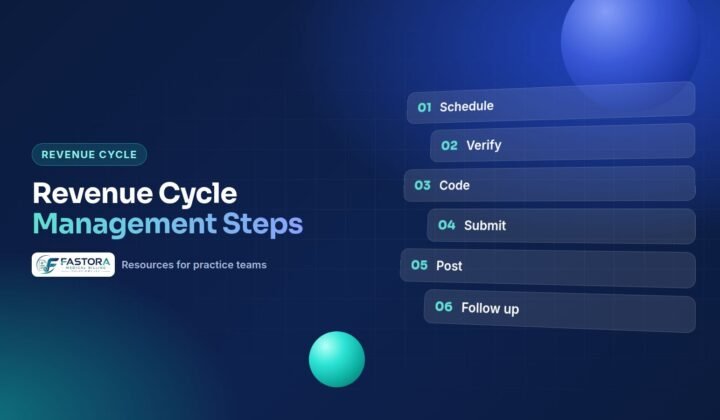
Our guide to the steps of the revenue cycle shows where each report originates — the review is simply where those stages are looked at together, on a schedule, instead of one at a time when something goes wrong.
The decisions good reporting actually supports
Reporting earns its place when it changes what a practice does. Three kinds of decision come up repeatedly in well-run reviews:
- Staffing and workload. Provider-level and front-end denial views show where work is concentrating. If eligibility denials trace to a rushed check-in at one location, the answer may be a changed intake step or added cover at a busy hour — a decision you can only make confidently when the pattern is documented rather than anecdotal.
- Payer contracts. Payer-level reporting is the evidence base for contract conversations. Payment speed, denial behavior, and payments measured against your expected rates, collected over months, turn a vague sense that a payer is difficult into a specific record you can raise with a payer representative — and, at renewal, into an informed judgment about which terms to push on.
- Service lines and scheduling. Collections by service line or location, seen over several months, inform questions no single month can answer: whether a service is covering its costs, whether a location’s payer mix is shifting, or whether added sessions are producing collectible revenue or mostly denials. These are the practice’s decisions, not the billing company’s — but they should be made from the revenue record, not from impressions.
Reporting does not make these decisions for you, and a good RCM partner does not pretend otherwise. Its job is to make the relevant facts arrive on time, in a form that can be acted on, with last month’s actions accounted for.
A short test to apply to any partner, including Fastora
Before signing, ask to see a sample monthly report — with another practice’s details removed — and ask who you would meet with to review it, what you can access directly between reports, and how review decisions are recorded and followed up. Specific or vague, the answers will tell you more about the relationship you are buying than any description of services.
Fastora works with 50+ active clients and reports in the pattern described here: a defined monthly package, payer- and provider-level views, direct visibility into the work in your own system, and a monthly review built around decisions and follow-through. If your current reporting is a single summary and a feeling that you cannot quite see your own revenue, a free medical billing audit is a practical starting point — it shows your denial patterns, aging, and reporting gaps as they stand today, before you decide whether to change anything.
Frequently asked questions
What reports should a medical billing company provide every month?
At minimum: charges, payments, and adjustments grouped by type; denials grouped by reason with follow-up status; A/R aging showing movement between buckets; and the same core figures broken down by payer and by provider. The package should use the same format each month so changes stand out, and it should come with a review conversation, not just a delivery.
What is the difference between a dashboard and a monthly report?
A dashboard shows where things stand right now, for checking a specific claim, payer, or balance between reviews. A monthly report covers a completed period, compares it with previous months, and explains what changed and why. Practices need both: the dashboard for access, the report for interpretation.
What should be decided in a monthly revenue review?
The review should end with recorded decisions, each with an owner and a date: which payer issues to escalate, which front-end or documentation step to change, how old balances will be handled, and what will be re-checked next month. It should also begin by reviewing whether last month’s decisions were carried out.
Can I see my billing data between monthly reports?
You should be able to. Ask any RCM partner, before signing, what direct access you keep to dashboards and to your own practice management system. A partner whose reports reconcile with what you can see in your own system is offering verifiable transparency; one that offers only its own summaries is asking to be taken on trust.
How does billing transparency help with payer contract decisions?
Payer-level reporting collected over months — payment speed, denial reasons, and payments compared with expected contract rates — gives you a specific record to raise with a payer representative and an evidence base at renewal. Without it, contract conversations rest on impressions, and underpayment can continue unnoticed.