
Where Is Your Practice’s Revenue Actually Going? The Hidden Cost of Medical Billing Leaks
Most providers assume that if patient volume is steady, revenue should be too. It rarely works out that way — and the reason usually isn’t patient volume at all.
A practice can be fully booked every week and still be quietly losing tens of thousands of dollars a year — not because care wasn’t delivered, but because the billing process behind it never fully caught up. This is the part of running a practice that’s easy to miss, because the money doesn’t disappear all at once. It leaks out a few dollars at a time: a denied claim nobody had time to rework, a visit that got undercoded, a prior authorization that slipped through, an unpaid balance that aged past the point it could still be collected. None of it shows up as a single alarming number. It shows up months later as a collections rate that’s lower than it should be and a cash flow that never quite matches the volume of patients seen.
The data backs this up at an industry level, and it’s worth understanding exactly where the money goes before looking at how to stop it.
How Much Revenue Are Providers Actually Losing?
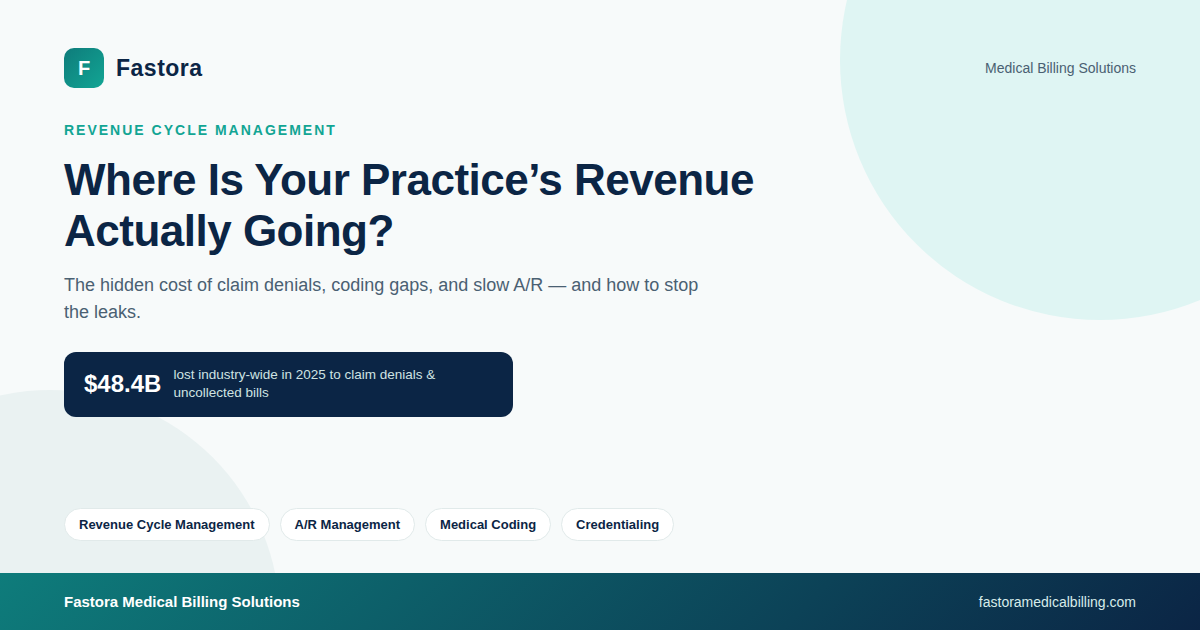
Per our research, U.S. healthcare providers lost $48.4 billion in 2025 to claim denials and uncollected patient bills, across thousands of hospitals and physician practices nationwide. Final denial rates rose year over year, and bad debt climbed alongside it.
That trend isn’t limited to large health systems. Per our research, 41% of providers now report denial rates above 10%, up from 38% in 2024 and just 30% in 2022 — a steady, three-year climb. Half of those providers point to the same root cause: missing or inaccurate claim data going out the door in the first place.
Once a claim is denied, the odds of it getting corrected and resubmitted aren’t great either. Industry estimates put the share of denied claims that are never reworked at 35% to 60%. Every one of those is revenue a practice already earned and simply wrote off, at an average rework cost of roughly $57 per claim even when staff do have the time to fix it.
None of this is a patient volume problem. It’s a revenue cycle management problem, and it’s largely preventable.
7 Places Revenue Quietly Disappears in Medical Billing
Claim denials that never get reworked. A denial isn’t a dead end — it’s a task. But most practices don’t have a dedicated person whose job is to research, correct, and resubmit every denied claim within the payer’s window, so a large share become permanent losses.
Undercoding and missed charge capture. Services get performed, documented, and then billed at a lower level than they should be — or left off the claim entirely. Accurate medical coding is one of the highest-leverage places to recover revenue, because the fix doesn’t require seeing more patients, just billing correctly for the ones already seen.
Eligibility and prior-authorization gaps. Missing or inaccurate coverage data is the single most common cause of denials. Per our research, physicians complete an average of 39 prior authorizations a week, spending roughly 13 hours weekly on the process — and every one of those is also a claim at risk of denial if it isn’t tracked and confirmed before the visit.
Claims that age past the timely filing deadline. Every payer has a filing window, typically 90 to 365 days depending on the plan. Without an active system tracking claim status, claims sit in accounts receivable until they quietly expire — at which point the revenue isn’t delayed, it’s gone permanently.
Slow accounts receivable (A/R) follow-up. Days in A/R is one of the clearest health signals a revenue cycle has. Under 30 days is considered excellent, 30–40 days is a healthy benchmark for most practices, and anything past 50 days signals real cash tied up in the pipeline.
Credentialing and enrollment delays. A provider who isn’t fully credentialed and enrolled with a payer can’t bill that payer, full stop. Delays here are one of the most common and most avoidable reasons new providers or new locations go weeks or months without collecting revenue they’ve already earned.
No real-time analytics or reporting. Many practices still manage billing off spreadsheets and month-end reports. By the time a denial trend or an aging A/R bucket shows up in the numbers, it’s already weeks old.
What This Actually Costs a Practice
These numbers compound. A practice running a 10%+ denial rate, with even a third of those denials never reworked, combined with A/R sitting past 50 days, isn’t looking at a minor inefficiency — it’s looking at a meaningful percentage of earned revenue that simply never converts to cash.
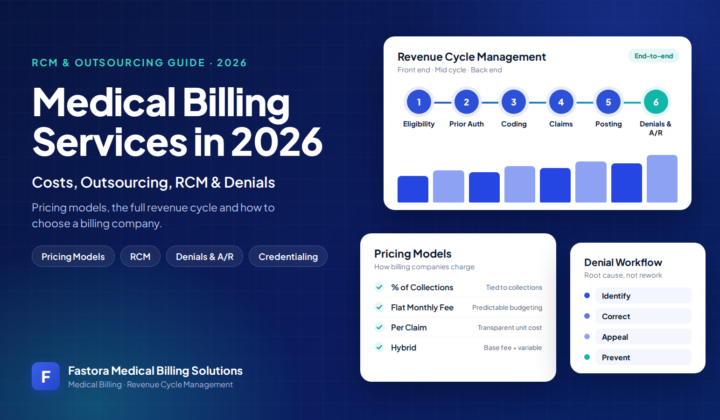
The in-house cost of trying to fix this internally is also higher than it looks on paper. A single in-house billing hire, once salary, benefits, software, and training are factored in, typically runs $65,000–$70,000 a year — for one person handling coding, submission, denial management, A/R follow-up, and credentialing all at once. Outsourced revenue cycle management, by comparison, is usually priced as a percentage of collections (commonly 3–9%), so the cost scales with what the practice actually collects.
How to Start Plugging the Leaks
A few practices can meaningfully improve their numbers without a full overhaul, just by tightening the basics: run a clean claim audit before submission rather than after denial, since catching errors on the front end is cheaper than fixing them on the back end. Build a denial management workflow with a firm turnaround time, so denied claims don’t sit untouched. Track days in A/R monthly, not annually, so a slowdown gets caught at 35 days instead of 65. Confirm eligibility and authorization before the appointment, not after the claim is denied. And put credentialing on a calendar with enough lead time that a new provider or new payer contract doesn’t sit idle for months.
For practices where none of that is realistic with current staff bandwidth, outsourcing medical billing and coding to a dedicated revenue cycle management company is usually the faster and more measurable fix.
How Fastora Medical Billing Solutions Helps
This is exactly the gap Fastora Medical Billing Solutions, a full-service medical billing company built around modern revenue cycle management (RCM), was created to close — and it maps directly to the leaks above:
Revenue Cycle Management — end-to-end, HIPAA-compliant claim submission, tracking, and follow-up, built around a 96%+ clean claim rate target so fewer claims are denied in the first place. A/R Management — active accounts receivable management and follow-up designed to keep days in A/R down rather than letting balances quietly age out. Practice Billing Audit — a direct look at where a specific practice’s revenue is currently leaking, before committing to anything else. Medical Coding — CPT, ICD-10, and HCPCS coding handled by certified coders, aimed at the 99% accuracy and 98% first-pass rate that prevents undercoding and denials at the source. Credentialing & Enrollment — payer applications and enrollment managed so new providers and new payer relationships start collecting sooner. Analytics & Reporting — real-time performance dashboards instead of a month-end surprise. EMS Billing Services — specialized support for ambulance and EMS billing, one of the more complex and error-prone billing categories in healthcare.
Practices working with Fastora have seen up to a 20% reduction in billing costs and up to a 30% increase in collected revenue, with no setup or software fees and 24/7 dedicated support — outcomes built on the same fundamentals covered above: clean claims, fast follow-up, and full visibility into where the revenue actually stands at any given moment.
Frequently Asked Questions
How much revenue do medical practices lose to billing errors?
Nationally, providers lost $48.4 billion in 2025 to claim denials and uncollected bills. At the practice level, the number varies, but a 10%+ denial rate combined with slow A/R follow-up commonly represents a meaningful share of a practice’s earned-but-uncollected revenue.
What is a good clean claim rate in medical billing?
Most high-performing practices and billing partners target a clean claim rate of 95% or higher — meaning that percentage of claims are accepted on first submission without needing correction or resubmission.
Should I outsource my medical billing?
If claim denials, aging A/R, or credentialing delays are eating into revenue and current staff don’t have the bandwidth to chase every claim, outsourcing to a dedicated medical billing company typically pays for itself through recovered revenue and reduced denial rates, often at a lower total cost than an additional in-house hire.
How much does it cost to outsource medical billing?
Outsourced medical billing is commonly priced as a percentage of monthly collections, typically in the 3–9% range, rather than a flat fee — so the cost scales with what the practice actually collects.
How can I reduce claim denials in my practice?
Confirm eligibility and prior authorization before the visit, audit claims for accuracy before submission, track denial trends by payer and reason code, and follow up on denials within the payer’s resubmission window rather than letting them age out.
The Bottom Line
Providers aren’t losing money because of fewer patients. They’re losing it in the space between delivering care and actually getting paid for it — a space most practices can’t fully see without dedicated systems and staff watching it.
See exactly where your revenue is leaking
Request a free claims audit and find out what recovering that revenue would look like for your practice.
Request a Free Claims Audit →