Running a healthcare practice involves much more than treating patients. Providers must also manage eligibility, coding, claims, insurance follow-up, denials, payments, and accounts receivable. When these billing tasks are delayed or handled incorrectly, payments can take longer to arrive and valuable revenue can remain stuck in unpaid claims. That’s where the best medical billing services in the United States make a measurable difference — helping practices submit cleaner claims, reduce avoidable delays, and maintain a healthier revenue cycle.
In this guide, we explain how medical billing services work, why they matter, and how practices can improve their payment cycle — and what to look for in a top medical billing company if you’re ready to outsource.
- What Are Medical Billing Services?
- Why Medical Practices Experience Payment Delays
- How Medical Billing Services Help Practices Get Paid Faster
- Key Medical Billing Metrics to Monitor
- In-House vs. Outsourced Medical Billing
- How to Choose a Medical Billing Company
- How Fastora Medical Billing Solutions Can Help
- Frequently Asked Questions
1. What Are Medical Billing Services?
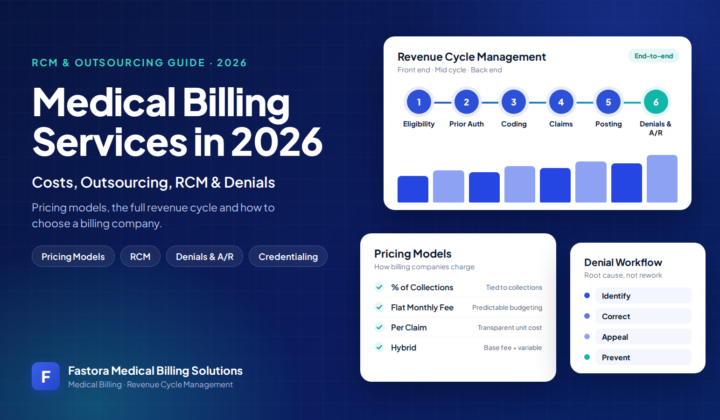
Medical billing services involve managing the administrative and financial processes required to receive payment for healthcare services. Depending on the practice’s needs, billing services may include:
Common Medical Billing Services
- Patient eligibility & insurance verification
- Prior authorization & referral verification
- Charge entry
- Medical coding & charge review
- Claim creation & electronic submission
- Claim rejection management
- Denial management
- Insurance payment posting
- ERA and EOB processing
- Accounts receivable follow-up
- Aging A/R management
- Corrected claims
- Appeals & reconsideration requests
- Patient statements
- Insurance credentialing & enrollment
- Payer portal & claim-status follow-up
The objective is to keep every stage of the revenue cycle organized so claims can move from service delivery to payment as efficiently as possible.
2. Why Medical Practices Experience Payment Delays
Many practices experience slow payments because problems can occur at multiple points in the revenue cycle.
1. Eligibility Errors
If a patient’s insurance coverage is inactive or the information submitted on the claim does not match the payer’s records, the claim may be rejected or denied. Verifying eligibility before the patient’s appointment can help identify coverage issues earlier.
2. Coding Errors
Incorrect CPT, HCPCS, or ICD-10 codes can create claim problems. Missing modifiers, incorrect diagnosis codes, or documentation and coding inconsistencies may also result in denials or requests for additional information. Accurate coding and charge review are therefore important parts of the billing process.
3. Claim Rejections
A rejected claim generally needs to be corrected and resubmitted before it can move forward for adjudication. Common rejection issues include:
- Incorrect patient information
- Invalid member ID
- Missing or invalid provider information
- Incorrect payer selection
- Missing required information
- Coding-related edits
- Enrollment or credentialing issues
Monitoring rejected claims quickly can prevent unnecessary delays.
4. Insurance Denials
A denied claim requires review to determine why payment was not issued. Depending on the denial reason, the appropriate action may include correcting the claim, submitting additional documentation, filing an appeal, requesting reconsideration, verifying authorization, correcting coding, or addressing eligibility or coverage issues. A structured denial-management process helps prevent unpaid claims from being overlooked.
5. Unworked Accounts Receivable
Accounts receivable can become a significant source of revenue leakage when unpaid claims are not followed up consistently. A strong A/R process categorizes outstanding claims by payer, age, balance, denial reason, and required action.
3. How Medical Billing Services Help Practices Get Paid Faster
Professional billing support can improve the revenue cycle by creating consistent processes throughout the billing workflow.
Step 1: Verify Patient Eligibility
Before services are provided, insurance eligibility and benefits can be verified to identify coverage limitations, inactive policies, copayments, deductibles, and referral or authorization requirements. Early verification helps reduce avoidable billing problems later.
Step 2: Review Charges and Coding
Once services are documented, charges should be reviewed for appropriate coding and billing requirements, including CPT codes, HCPCS codes, ICD-10 diagnosis codes, modifiers, units, place of service, provider information, and payer-specific requirements. Accurate information gives claims a better chance of processing without preventable errors.
Step 3: Submit Claims Promptly
Claims should be submitted as soon as the required information is available. Electronic claim submission can help practices transmit claims efficiently while allowing billing teams to monitor claim acceptance and rejection status.
Step 4: Monitor Rejected Claims
A claim rejection should not sit unresolved. Billing staff can review rejection reports, identify the issue, correct the claim, and resubmit it according to the payer’s requirements.
Step 5: Track Claim Status
Submitting a claim is only one part of the process. Billing teams should monitor outstanding claims through payer portals, clearinghouses, electronic responses, and other available channels. Claims that remain pending beyond expected processing periods may require follow-up.
Step 6: Work Denials
Denial management is one of the most important components of an effective revenue cycle. Each denial should be reviewed to determine why the claim was denied, whether it can be corrected, whether additional documentation is required, whether an appeal is appropriate, whether a corrected claim should be submitted, and what deadline applies. The goal is not simply to appeal every denial — it’s to identify the appropriate action for each claim.
Step 7: Post Payments Accurately
When insurance payments and adjustments are received, they should be posted accurately against the corresponding patient accounts. Proper payment posting helps practices identify underpayments, remaining balances, incorrect adjustments, patient responsibility, unpaid claims, and secondary billing opportunities.
Step 8: Follow Up on A/R
Outstanding balances should be regularly reviewed and prioritized — focusing on high-dollar claims, older claims, claims approaching filing or appeal deadlines, repeatedly denied claims, claims requiring medical records, and claims pending with insurance companies. Consistent follow-up can help prevent aging balances from becoming difficult to recover.
4. Key Medical Billing Metrics Practices Should Monitor
Healthcare providers should not evaluate their billing process solely by how many claims are submitted. Several revenue-cycle metrics can provide a clearer picture of billing performance.
5. In-House Billing vs. Outsourced Medical Billing Services
Practices generally have two options: manage billing internally or work with an external medical billing company.
In-House Medical Billing
Gives the practice direct control over its billing staff and processes. However, maintaining an internal billing department can require investment in:
- Employees & training
- Billing software & clearinghouse services
- Technology & compliance procedures
- Management & staff coverage
Outsourced Medical Billing
A top medical billing company provides specialized billing support without requiring the practice to build a complete billing department internally. Depending on the agreement, the billing company may handle:
- Claims, denials & appeals
- A/R follow-up & payment posting
- Eligibility & authorizations
- Credentialing & other revenue-cycle functions
The right approach depends on the practice’s size, specialty, staffing, technology, budget, and operational requirements.
6. How to Choose a Medical Billing Company
Before selecting a billing partner, healthcare providers should evaluate several factors:
Experience With Your Specialty
Billing requirements differ significantly between specialties. Ask whether the company has experience with your type of practice and payer mix.
Revenue Cycle Services
Determine exactly which services are included — eligibility, authorizations, coding, claims, denials, appeals, payment posting, A/R, patient billing, and credentialing.
Communication
A billing partner should have a clear process for communicating claim issues, outstanding A/R, denials, and important account updates.
Reporting
Ask what reports will be provided and how often — A/R aging, claim status, denial reports, payment reports, production and collection reports.
Technology and Workflow
A billing company should be able to work with the systems and workflows already used by your practice.
Data Security and Compliance
Healthcare billing involves protected health information. Evaluate a vendor’s security practices, access controls, and applicable compliance requirements before sharing patient data.
7. How Fastora Medical Billing Solutions Can Help
At Fastora Medical Billing Solutions LLC, we provide medical billing and revenue cycle management support designed to help healthcare practices manage the administrative side of reimbursement — the kind of end-to-end support providers look for from the best medical billing services in the United States.
Our Services Include
- Medical billing & revenue cycle management
- ICD-10, CPT & HCPCS coding support
- Charge review
- Insurance eligibility verification
- Prior authorization & referral support
- Charge entry & electronic claims
- Claim rejection & denial management
- Accounts receivable follow-up
- Appeals & corrected claims
- EOB and ERA payment posting
- Patient statements
- Aging A/R management
- Credentialing & recredentialing
- Payer enrollment & related admin support
We support practices across multiple specialties and tailor billing workflows to the needs of each organization — which is why practices searching for a top medical billing company consistently turn to Fastora for dependable, transparent revenue cycle management.
Ready to Get Paid Faster?
Talk to Fastora Medical Billing Solutions LLC about a free claims audit for your practice.
Request a Free Claims AuditFinal Thoughts
Getting paid faster is not simply about submitting more claims. It requires a coordinated revenue-cycle process that begins with eligibility and accurate documentation and continues through coding, claim submission, rejection management, denial follow-up, payment posting, and A/R management.
For healthcare practices, identifying where claims are getting delayed or revenue is being lost can be the first step toward improving the billing process. A structured medical billing strategy — backed by the best medical billing services in the United States — can help practices spend less time on administrative billing tasks and more time focusing on patient care and practice operations.
8. Frequently Asked Questions
What do medical billing services typically include?
Medical billing services generally cover eligibility verification, coding and charge review, claim submission, rejection and denial management, payment posting, and accounts receivable follow-up — everything needed to turn a rendered service into collected revenue.
How does outsourcing to a top medical billing company help a practice get paid faster?
A specialized billing company brings dedicated staff, payer-specific expertise, and consistent A/R follow-up that many in-house teams don’t have the bandwidth to maintain, which typically shortens days in A/R and reduces denials.
What is a good clean claim rate?
While benchmarks vary by specialty and payer mix, a higher clean claim rate means fewer claims need correction and resubmission — which directly speeds up payment and reduces administrative rework.
What should I look for in the best medical billing services in the United States?
Look for specialty experience, full revenue-cycle coverage (not just claim submission), clear reporting, compatible technology, and strong data security and compliance practices.