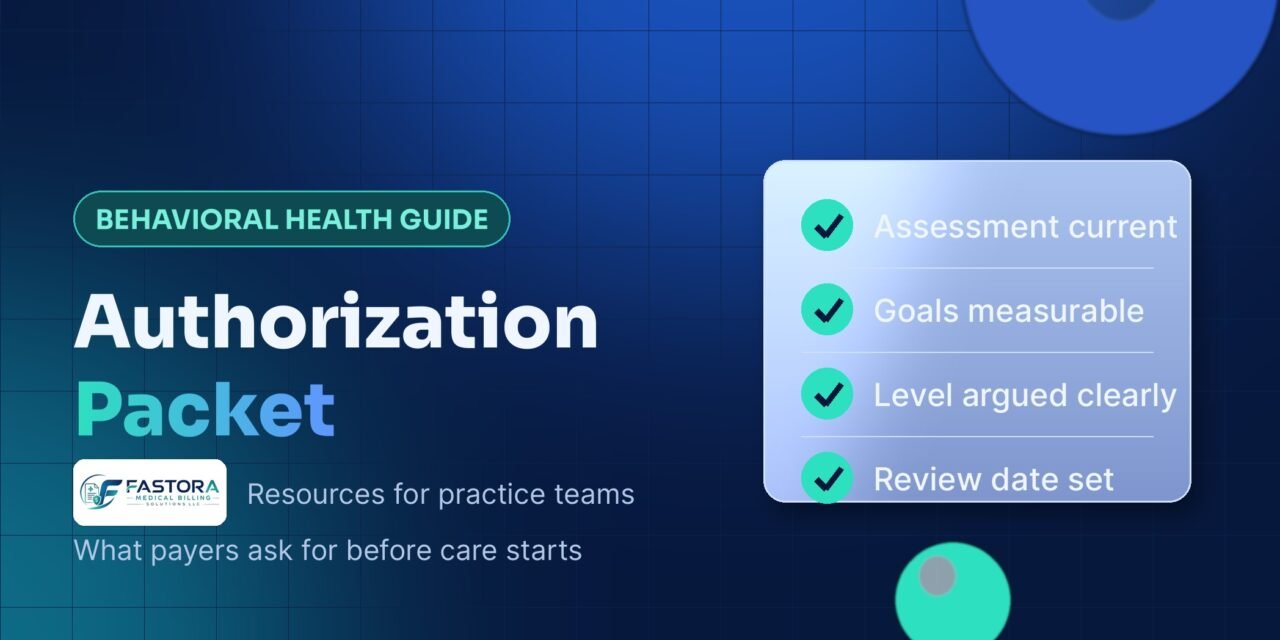
A behavioral-health authorization rarely fails because care was unnecessary. More often, the request arrives incomplete: the assessment is there, but the treatment plan has no measurable goals; the level of care is named, but nothing explains why that level — and not a lower one — is needed now.
That gap between “clinically true” and “documented completely” is where authorizations stall. This guide covers what a complete behavioral health prior authorization documentation packet contains, how it changes for concurrent review, where packets fall short, and a short pre-send routine to use every time. Requirements vary by payer, plan, and contract — always confirm the specific plan’s rules before you submit.
What the documentation has to prove
An authorization reviewer answers three questions from paper alone:
- Who is this patient, clinically? Diagnosis, presenting symptoms, and functional status — how the condition affects daily life, work or school, and safety.
- What care is requested, exactly? Service type, level of care, frequency, and expected duration, in the payer’s own terms.
- Why this care, at this level, now? The reasoning connecting the assessment to the request, including what has already been tried.
If any answer is missing or vague, the reviewer cannot approve from the paper alone — even when the care is appropriate. Good documentation is not longer documentation; it is documentation where those three answers are easy to find.
The initial authorization packet
For a first request — outpatient therapy with an authorization requirement, or admission to intensive outpatient, partial hospitalization, residential, or inpatient care — a complete packet typically includes the following. Fastora’s prior authorization service starts from this same checklist, adapted to each plan’s format.
1. Clinical assessment summary
A current, dated assessment naming the evaluator and credentials. State the presenting problem in current terms (not only history), relevant psychiatric and medical history, substance-use history where applicable, current medications, and prior treatment with outcomes. Reviewers look for recency: an assessment that predates a significant clinical change reads as stale, even if thorough.
2. Diagnosis
Primary and secondary diagnoses the rest of the packet actually supports. Every requested service should trace back to a documented diagnosis, and the severity described should match the level of care requested. A mismatch — mild symptoms paired with the highest level of care, unexplained — is a fast route to a request for more information.
3. Treatment plan with measurable goals
Goals written so progress can be observed: what will change, in what timeframe, and how the team will know. “Improve coping” is a wish; “reduce panic episodes from daily to twice weekly within eight weeks, tracked by patient log” is a plan. Include planned interventions, frequency, who provides each service, and family or collateral involvement where relevant.
4. Level-of-care rationale
A short, explicit paragraph: why is this level required, what lower level was considered, and why would it be insufficient or unsafe now? For substance-use requests, payers commonly expect the reasoning organized by recognized dimensions (withdrawal risk, biomedical and emotional/behavioral conditions, readiness, relapse risk, recovery environment). You need not name a framework unless the plan requires one — but that reasoning should be visible.
5. Risk and functional status
Current risk assessment (harm to self or others, grave disability, safeguarding concerns) and functional impairment in concrete terms: missed work or school, self-care decline, relationship breakdown, repeated crises. Function often decides between levels of care, so use observable terms, not adjectives.
6. History that supports the request
Prior treatment and medication history with dates, duration, response (helped, partially helped, not tolerated), and reason for any change. For requests after failed lower-level treatment, this history is the argument — make it complete and chronological.
Illustrative example only — not a payer rule. A request for intensive outpatient care might organize its rationale as: current symptoms and function (daily panic, unable to sustain work shifts), what was tried (ten weeks of weekly outpatient therapy plus two medication trials, with partial response), why weekly care is now insufficient (symptom frequency is increasing between sessions and safety planning requires more frequent contact), and the measurable goal for the IOP episode (sustain full work shifts and reduce episodes to twice weekly, reviewed at concurrent review). Same facts, presented as an argument instead of a pile of notes.
The concurrent-review packet: continuing care
Authorization for ongoing higher levels of care is not a resubmission of the first packet. Reviewers want to know what has changed:
- Updated progress notes tied to the treatment-plan goals — not “patient progressing,” but progress against each measurable goal.
- Current symptoms, risk, and function, compared with admission status.
- Medication or plan changes and the reason for each.
- Barriers and what the team is doing about them (attendance, engagement, medical issues).
- Active discharge planning: the step-down target, what must be true before step-down is safe, and the aftercare arrangement being built.
Send updates in the window the plan specifies and keep the authorization number, dates, and approved units reconciled with scheduling. An untracked authorization quietly expires — and the claims that follow it deny. If tracking renewals has become its own job, that is the operational gap Fastora’s behavioral health billing guide places inside the wider revenue cycle.
Where packets fall apart
These are documentation problems, not clinical ones, and they are preventable:
- Goals that cannot be measured, so concurrent review has nothing to measure against.
- Level-of-care requests with no rationale — the level is named, never argued.
- Stale or copy-forward notes that describe last month’s patient, not this week’s.
- History with gaps: medication trials listed without dates or duration, so adequacy cannot be judged.
- Diagnosis, assessment, and request that disagree with each other.
- Missing basics: wrong member or provider identifiers, dates of service that do not match the request, or the packet sent to the wrong plan.
This list is upstream only — the packet before care starts. The downstream picture, why claims deny after care is billed, is covered separately in Fastora’s guide to mental health claim denials and how to prevent them.
A pre-send routine owners can standardize
- Confirm the requirement first. During eligibility verification, confirm whether this service, for this plan, needs authorization — and note the submission channel and timeframe required.
- Assemble against the checklist, not from memory. Assessment, diagnosis, measurable plan, level-of-care rationale, risk/function, history. One owner, one place it lives.
- Read it as the reviewer. Can a stranger answer who / what / why-this-level from the packet alone? If a fact lives only in someone’s head, it is not in the request.
- Log the submission immediately. Date sent, channel, authorization number when issued, approved dates and units, and concurrent-review due date — where scheduling and billing can both see it.
- Calendar the next step before closing the file. Renewal, concurrent review, or peer-to-peer window gets a date and an owner now, not when someone notices a lapse.
Frequently asked questions
Does every behavioral-health service need prior authorization?
No. Requirements vary by payer, plan, service type, and sometimes visit count or diagnosis. Many standard outpatient services for in-network providers do not require authorization, while intensive outpatient, partial hospitalization, residential, inpatient, psychological testing, and certain other services commonly do. Confirm requirements for the specific plan during eligibility verification, before the visit — never from habit.
What documentation is needed for a mental health prior authorization?
Typically: a current clinical assessment, supported diagnoses, a treatment plan with measurable goals, an explicit level-of-care rationale, risk and functional status, and relevant treatment and medication history. For continuing care, add updated progress against those goals and active discharge planning. The exact list and format vary by plan, so confirm the plan’s checklist before assembling the packet.
How is concurrent review different from the initial authorization?
The initial request argues why care should start at a given level. Concurrent review argues why it should continue: progress measured against the original goals, current risk and function, changes to the plan, and discharge planning. Re-sending the admission packet without updates is one of the most common reasons continuing-care requests stall.
What happens if documentation is incomplete?
Usually delay first: the payer requests more information, and care or billing waits. If the missing piece goes to the heart of medical necessity, the request can be denied, with a limited window to request a peer-to-peer discussion. Either way, your team spends the time twice — once treating, once re-explaining the treatment on paper.
Who should own the authorization packet — clinicians or billing?
Both, with clear halves. Clinicians own the clinical content (assessment, plan, rationale). The billing or authorization team owns completeness, plan-specific format, submission, tracking, and renewal dates. Most failures happen in the handoff, which is why a single checklist and a single log matter more than either team’s effort alone.
Conclusion
Behavioral health prior authorization documentation is an argument, not an attachment pile: who the patient is clinically, what care is requested, and why that level is needed now — updated honestly as care continues. Standardize the packet, read it once as the reviewer, and log every approval against scheduling, and the preventable “more information” delays largely disappear.
If authorization packets and renewals are eating clinical time, Fastora can take that workflow on. Start with a free billing assessment: we will show you where the packet breaks down — no obligation, just a clear map of what to fix first.