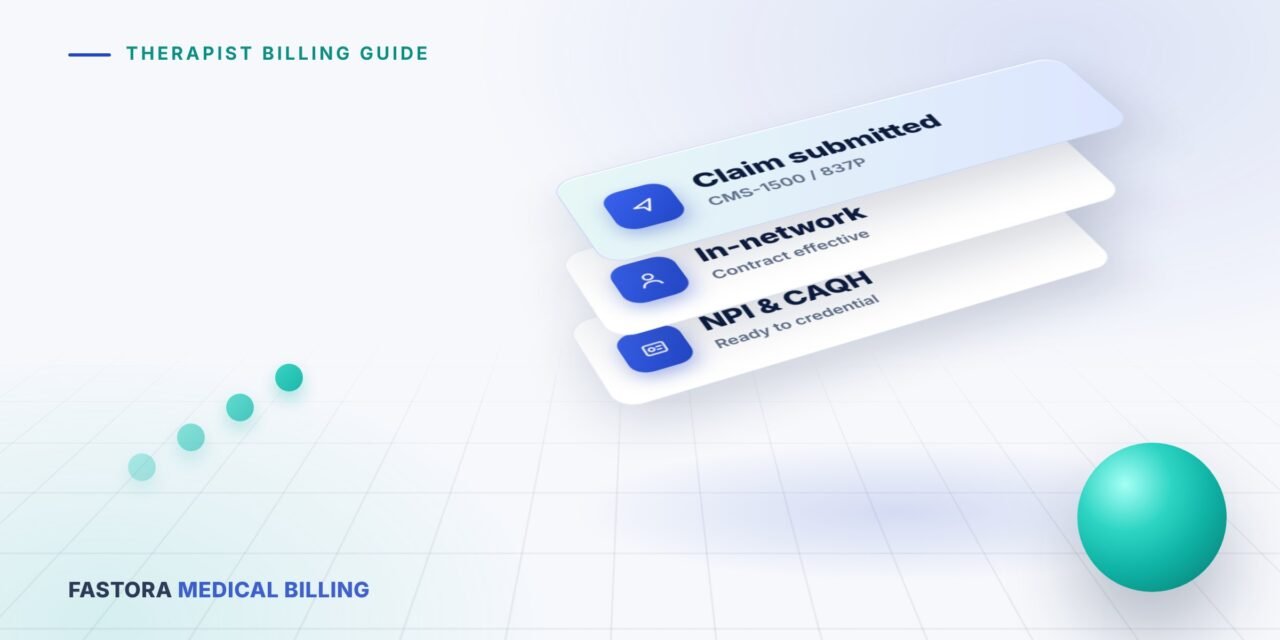
Therapist Billing Guide
Most therapists are trained to treat clients, not to chase insurance claims. Yet for a private practice that accepts insurance, billing is what turns a full caseload into a working business. The process has more steps than most clinicians expect, and a gap at any step, from credentialing to the claim form itself, can hold up payment for months.
This guide explains how to bill insurance as a therapist, step by step. It is written for licensed clinical social workers (LCSWs), licensed professional counselors (LPCs) and licensed mental health counselors, licensed marriage and family therapists (LMFTs) and psychologists who are starting to accept insurance or tightening up an existing process.
Key takeaways
- Credentialing and contracting must be complete before you see a plan’s clients.
- Verify benefits, who administers mental health coverage, and authorization rules before the first session.
- Since January 1, 2024, Medicare enrolls marriage and family therapists and mental health counselors.
In this guide
- 01The insurance billing process at a glance
- 02Step 1: Get your NPI, taxonomy code and CAQH profile
- 03Step 2: Get credentialed and contracted with insurance plans
- 04Step 3: Set up electronic claims, ERA and EFT
- 05Step 4: Verify benefits before the first session
- 06Step 5: Obtain prior authorization when required
- 07Step 6: Document each session to support the claim
- 08Step 7: Code the session correctly
- 09Step 8: Submit a clean claim
- 10Step 9: Post payments and bill the client
- 11Step 10: Follow up on unpaid and denied claims
- 12In-network, out-of-network and superbills
- 13Frequently asked questions
The insurance billing process at a glance
Every insurance-based therapy practice follows the same basic sequence, whether the billing is done in-house or outsourced:
- Get the identifiers and enrollments in place (NPI, taxonomy, CAQH).
- Get credentialed and contracted with each insurance plan you want to accept.
- Set up electronic claims, remittances and payments.
- Verify each client’s benefits before the first session.
- Obtain prior authorization when the plan requires it.
- Document each session to support the code you will bill.
- Code the service with the correct CPT and ICD-10-CM codes.
- Submit a clean claim.
- Post payments and bill the client their share.
- Follow up on unpaid and denied claims.
The sections below walk through each step and the mistakes that most often delay payment.
Step 1: Get your NPI, taxonomy code and CAQH profile
The National Provider Identifier (NPI) is the 10-digit number that identifies you on every claim. You apply for it through NPPES, the national enumeration system run on behalf of CMS. There are two types:
- Type 1 (individual): every licensed clinician who renders services needs one.
- Type 2 (organization): needed if your practice is a group or incorporated entity that bills under its own tax ID.
When you register, you choose a taxonomy code that describes your provider type, such as clinical social worker, counselor, marriage and family therapist or psychologist. The taxonomy should match your license, because payers use it to decide what you can bill.
Most commercial plans also require a completed CAQH ProView profile. CAQH is a shared credentialing database that insurers pull from. You enter your education, license, malpractice coverage, work history and practice locations once, then re-attest periodically (generally every 120 days) so plans can rely on the information.
Step 2: Get credentialed and contracted with insurance plans
Credentialing is the insurer’s process of verifying your qualifications. Contracting is the agreement that makes you an in-network provider and sets your fee schedule. They often happen together, but they are separate: being credentialed does not by itself mean you have a signed contract.
A few points that trip up new practices:
- Mental health benefits are often carved out. Many health plans contract a separate managed behavioral health organization to administer mental health benefits. You may need to credential with that organization, not the medical plan whose name is on the client’s card.
- Panels can be closed. Some plans limit new providers in areas they consider well served. Ask about panel status before investing time in an application.
- Medicare now covers more therapist types. Since January 1, 2024, marriage and family therapists and mental health counselors (which includes many LPCs and LMHCs) can enroll in Medicare and bill for their services. Clinical social workers and psychologists were already eligible.
- Pre-licensed clinicians usually cannot bill under their own NPI. Associates and interns working toward licensure often cannot be credentialed independently. Payer rules for billing their services under a supervisor vary and many plans do not allow it at all, so check each plan’s policy in writing.
Do not see clients under a plan until you have a confirmed effective date. Claims for dates of service before your effective date are commonly denied, and retroactive effective dates are not guaranteed. Our guide to insurance credentialing for therapists covers the process in more detail.
Step 3: Set up electronic claims, ERA and EFT
Paper claims still exist, but electronic billing is faster and easier to track. You will need:
- A practice management or EHR system that creates claims in the standard electronic format (the 837P professional claim).
- A clearinghouse that checks claims for formatting errors and routes them to each payer. Many therapy EHRs include one.
- Electronic remittance advice (ERA) enrollment, so payment details (the 835 file) arrive electronically and can be posted automatically.
- Electronic funds transfer (EFT) enrollment, so payments are deposited directly into your bank account.
ERA enrollment is usually tied to your clearinghouse, and EFT enrollment is tied to your bank account. Both are set up payer by payer, which is why they are easy to miss when you add a new plan.
Step 4: Verify benefits before the first session
Insurance verification protects both you and the client from surprises. Before the first appointment, confirm:
- The plan is active and the client is the covered member (or a covered dependent).
- Outpatient mental health benefits are included, and who administers them.
- You are in network for that specific plan or product.
- The deductible, how much of it has been met, and the copay or coinsurance for therapy.
- Any visit limits, and whether prior authorization is required.
- Whether telehealth is covered, if you see clients virtually.
Record the date, the source (portal or phone call) and, for phone calls, the representative’s name and a reference number. Recheck coverage periodically, at least at the start of each year and whenever a client mentions a job or plan change.
Step 5: Obtain prior authorization when required
Many plans do not require authorization for routine outpatient psychotherapy, but some do, especially Medicaid managed care plans and some employer plans. Authorization is more commonly required for higher levels of care, psychological testing and extended sessions. When authorization is required, track the number of approved sessions and the end date so you can request more before they run out. Sessions provided after an authorization expires are a common, avoidable denial.
Step 6: Document each session to support the claim
Your progress note is the evidence behind every claim. Insurers can request records to confirm that the service was medically necessary and that the code matches what happened. A billing-ready note includes the date, total session time (and start and stop times where the payer expects them), who attended, the interventions used, the client’s response, and the diagnosis being treated. An up-to-date treatment plan with measurable goals supports ongoing care.
Step 7: Code the session correctly
Each claim line combines a CPT procedure code with at least one ICD-10-CM diagnosis code.
| Service | CPT code | Key rule |
|---|---|---|
| Intake assessment | 90791 | Not time-based; usually not billed with psychotherapy on the same day |
| Individual psychotherapy, 16 to 37 minutes | 90832 | Time-based |
| Individual psychotherapy, 38 to 52 minutes | 90834 | Time-based |
| Individual psychotherapy, 53 minutes or more | 90837 | Time-based; some payers monitor frequency |
| Family psychotherapy with client present | 90847 | Billed under the identified client |
| Family psychotherapy without client present | 90846 | Must relate to the client’s treatment |
| Group psychotherapy | 90853 | Billed per client attending |
The diagnosis should be the condition you are treating, coded to the highest specificity the documentation supports. Z codes (factors influencing health status) can describe circumstances, but many plans will not pay for psychotherapy when a Z code is the only or primary diagnosis. For a fuller reference, see our guide to mental health CPT codes.
Step 8: Submit a clean claim
A clean claim is accurate and complete the first time. On the CMS-1500 form (or its electronic equivalent), the details that cause the most rejections in therapy practices are:
- Client name, date of birth and member ID that do not exactly match the insurer’s records.
- The wrong rendering provider NPI, or a group NPI in the rendering field.
- A missing or incorrect place of service code, especially for telehealth (02 or 10).
- Diagnosis pointers that do not link each service line to a diagnosis.
- A missing authorization number when one is required.
- Billing the wrong payer, such as the medical plan instead of the behavioral health administrator.
Submit claims promptly. Every payer has a timely filing limit, and some are as short as 90 days from the date of service.
Step 9: Post payments and bill the client
When the payer processes the claim, the ERA or explanation of benefits (EOB) shows what was allowed, what was paid, any contractual adjustment, and the client’s responsibility. Post each payment and adjustment to the client’s account, then bill the client only the amount the payer assigns to them. As an in-network provider, you generally cannot bill the client for the difference between your full fee and the contracted rate.
For clients who are uninsured or choose to self-pay, federal No Surprises Act rules require a good faith estimate of expected charges. Collect copays at the time of service where you can; balances are harder to collect later.
Step 10: Follow up on unpaid and denied claims
Run an accounts receivable report at least weekly and look at claims by age. Anything unpaid after 30 days deserves a status check. For denials, read the claim adjustment reason code, fix the cause, and either submit a corrected claim or file an appeal within the payer’s deadline. Our guide to mental health claim denials covers the most common reasons and how to prevent them.
In-network, out-of-network and superbills
Some therapists stay out of network and give clients a superbill, an itemized statement with CPT codes, diagnosis codes, dates, fees and the provider’s NPI, so clients can seek reimbursement from their own plan. This reduces administrative work for the practice, but the client carries the reimbursement risk and the out-of-network benefit is often limited. Many practices use a mix: in network with a few plans that cover most of their local clients, out of network with the rest.
Frequently asked questions
Can I bill insurance before I am credentialed?
Generally no. Claims for sessions before your effective date with a plan are usually denied. A few plans allow limited retroactive effective dates, but you should not rely on that without written confirmation.
Which claim form do therapists use?
Professional services are billed on the CMS-1500 form, or electronically in the equivalent 837P format. Facility programs may use other formats.
Can LPCs and LMFTs bill Medicare?
Yes. Since January 1, 2024, Medicare allows marriage and family therapists and mental health counselors who meet its requirements to enroll and bill for covered services.
How long does it take to get paid by insurance?
Clean electronic claims are often paid within a few weeks, but timing varies by payer. Claims with errors, missing authorizations or credentialing issues can take months to resolve.
Should a solo therapist outsource billing?
It depends on claim volume, how much time billing takes away from clinical work, and the size of any unpaid backlog. Compare the full cost of doing it yourself, including your time and unpaid claims, against a billing service’s fees.
Work with Fastora
Spend your time on clients, not claims
Learning how to bill insurance as a therapist is worth the effort, because understanding the process helps you spot problems early. Doing all of it yourself, every week, is a different decision.
Fastora Medical Billing Solutions supports therapists and behavioral health practices with eligibility verification, prior authorization, credentialing, claim submission, payment posting, denial management and A/R follow-up. To see how that could work for your practice, explore our billing services for therapists or reach out to Fastora.