How TMS billing differs from routine psychiatry claims
Transcranial magnetic stimulation (TMS) is billed as a course of treatment, not a series of unrelated visits. A typical acute course runs five days a week for several weeks, so TMS billing means tracking one authorization, one set of medical-necessity records and a running count of sessions across dozens of claims.
That structure creates risks that do not exist in routine medication management. A course can be approved for fewer sessions than the clinician planned, a date can fall outside the authorized window, or a motor threshold re-determination can be coded on the wrong day. Each of these produces a denial that is easy to prevent and slow to fix.
This guide covers the three CPT codes, how payers decide coverage, what to document and how to keep a course on track. For the wider set of psychiatry and psychotherapy codes, see the behavioral health billing guide.
TMS CPT codes 90867, 90868 and 90869 explained
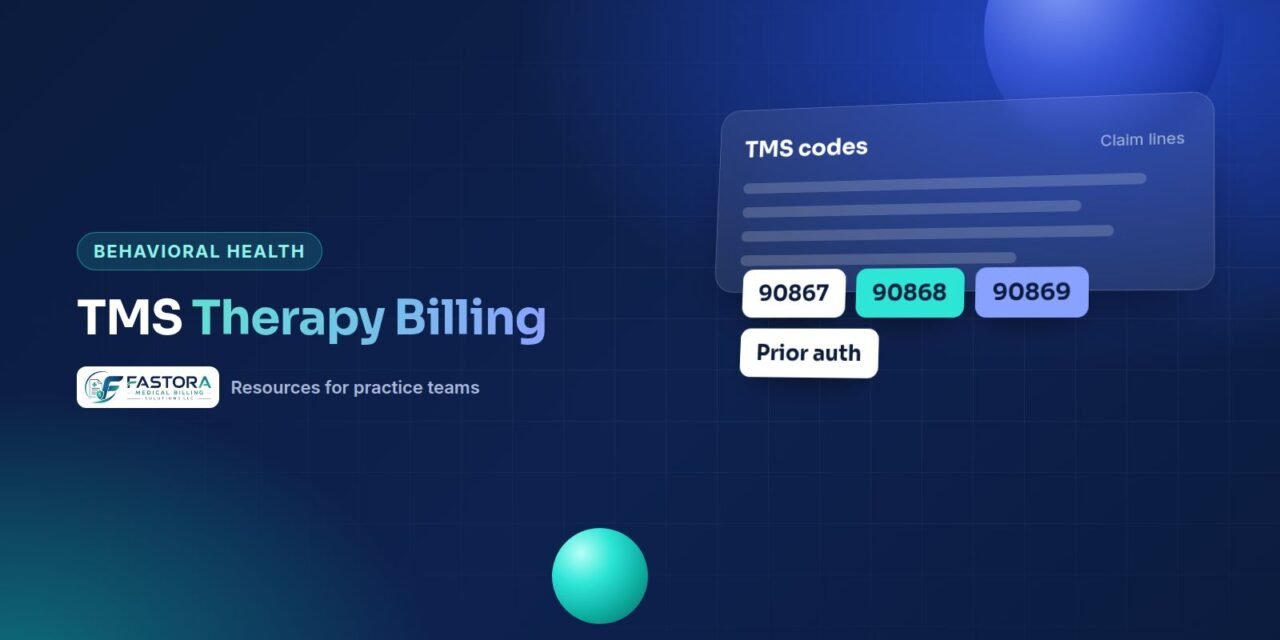
All three codes describe therapeutic repetitive TMS treatment. The difference is what happens at the session: the first treatment with full mapping, an ordinary treatment session, or a session where the motor threshold has to be measured again.
| Code | What it describes | How it is typically used |
|---|---|---|
| 90867 | Initial treatment, including cortical mapping, motor threshold determination, delivery and management | Reported once at the start of a course of treatment |
| 90868 | Subsequent delivery and management, per session | Reported for each routine treatment session after the first |
| 90869 | Subsequent motor threshold re-determination with delivery and management | Reported when the motor threshold is re-measured during the course, for example after a medication change |
CPT instructs that only one of these codes is reported for a given session, so a session with re-determination is billed as 90869 alone, not 90868 plus 90869. CPT also bars reporting the TMS codes with certain nerve conduction and evoked potential codes, so check the parenthetical notes in the current code book before adding diagnostics on the same date.
Medicare contractors generally expect 90867 once per course. If a patient returns months later for a new course after a relapse, the payer's policy decides whether a new initial code is allowed, so confirm that before the first session of the repeat course.
Coverage criteria payers check before approving TMS
Most coverage policies, including the Medicare local coverage determinations (LCDs) that apply in many states, limit TMS to adults with major depressive disorder who have not responded to, or could not tolerate, prior treatment. The details vary by payer, and they change, so pull the current policy for each plan rather than relying on last year's checklist.
Criteria that appear in many policies include:
- A confirmed diagnosis of major depressive disorder, often limited to severe episodes without psychotic features
- A documented number of failed antidepressant trials at adequate dose and duration, or documented intolerance
- A trial of evidence-based psychotherapy, in some policies
- Use of a standardized depression rating scale at baseline, with repeat scores during treatment
- An order and treatment plan from a psychiatrist or other qualified physician, with physician supervision of treatment
- Exclusions such as certain implanted metal devices near the head or an active seizure risk
Diagnosis codes matter here. Many policies list covered ICD-10-CM codes from the F32 and F33 categories, for example F32.2 (major depressive disorder, single episode, severe without psychotic features) and F33.2 (major depressive disorder, recurrent severe without psychotic features). Check the covered code list in the payer's billing article; an unspecified depression code is a common reason for denial.
Prior authorization and session limits
Commercial plans and Medicaid managed care plans almost always require prior authorization for TMS. Medicare does not use prior authorization for TMS in traditional fee-for-service, but Medicare Advantage plans often do. Build the authorization request from the same records you will later use to defend the claim.
Authorizations usually approve a set number of sessions within a date range. Track both. A claim for session 31 on an authorization for 30, or a session one day after the approval expires, will deny even though the treatment was appropriate.
- Confirm eligibility and behavioral health benefits, including whether TMS is carved out to a separate behavioral health vendor.
- Submit the authorization with the diagnosis, medication history, rating scale scores and treatment plan.
- Record the approved session count, start and end dates and the codes approved.
- Request a continuation or taper extension before the count runs out, with updated rating scale scores.
- Reconcile billed sessions against the authorization weekly.
For a broader look at approval workflows, see our prior authorization services page.
Documentation that supports each TMS claim
Payers reviewing TMS claims look at the course as a whole. The initial evaluation must show why TMS is medically necessary, and each session note must show that the treatment was delivered as planned under appropriate supervision.
- Initial psychiatric evaluation with diagnosis, symptom severity and medication trial history (drug, dose, duration, outcome)
- Baseline depression rating scale score and the instrument used
- Cortical mapping and motor threshold results for 90867 and each 90869
- Session notes with date, stimulation parameters, treatment location, duration, patient tolerance and adverse events
- Name of the supervising physician and the staff member who delivered treatment
- Repeat rating scale scores at the intervals the payer requires, which support continuation and taper requests
If a separate evaluation and management (E/M) visit happens on a treatment day, it needs its own note showing a significant, separately identifiable service, and modifier 25 on the E/M line. Routine check-ins during treatment are part of the TMS code and are not billed separately.
Common TMS billing denials and how to prevent them
| Denial reason | Typical cause | Prevention |
|---|---|---|
| No authorization or units exceeded | Session count or date range not tracked | Reconcile sessions to the authorization every week |
| Diagnosis not covered | Unspecified or moderate depression code on the claim | Code to the documented severity and match the payer's covered list |
| Duplicate or bundled service | 90868 and 90869 billed on the same date, or 90867 repeated | Bill one TMS code per session and 90867 once per course |
| Medical necessity not met | Medication trial history missing doses or durations | Use a structured intake form for prior trials |
| E/M denied | No separately identifiable service or missing modifier 25 | Bill an E/M only when the note supports it |
Because a course generates many claims with the same pattern, one setup error repeats across every session. Reviewing the first two or three claims of each new course before the rest go out catches that kind of problem early. Our guide on how to reduce claim denials covers the same front-end checks for other services.
Getting help with TMS claims
Fastora's certified billing and coding professionals work with psychiatry practices on authorization tracking, TMS code selection and denial follow-up inside the practice's existing EHR. Learn more about our psychiatric billing support, or request a free claims audit to review recent TMS claims before your next course starts.
Working with a TMS billing company
A TMS billing company handles the authorizations first and the claims second: most payers require prior authorization for transcranial magnetic stimulation, with documented failed medication trials in the packet. Our team assembles that documentation, tracks the authorized session count and bills the daily treatment codes against it — so the claim carries the auth number and the session count stays inside the approval.
What does a TMS billing company handle day to day?
Benefit verification for the TMS benefit specifically, authorization submission and tracking, daily claims for the treatment series and appeals when a payer cuts the series short. Related reading: behavioral health billing guide, psychiatric billing page, medical billing services.
Frequently asked questions
Can 90867 be billed more than once for the same patient?
It is generally reported once per course of treatment. Whether a new course after relapse allows another initial code depends on the payer's policy, so confirm it before treatment begins.
Is 90869 billed in addition to 90868?
No. CPT instructs that only one TMS code is reported per session. A session with motor threshold re-determination is billed as 90869 alone.
Does Medicare require prior authorization for TMS?
Traditional Medicare does not use prior authorization for TMS, but coverage still depends on meeting the local coverage determination criteria. Medicare Advantage, Medicaid and commercial plans commonly require authorization.
Can an E/M visit be billed on a TMS treatment day?
Only when a significant, separately identifiable service is performed and documented, such as a medication management visit. Append modifier 25 to the E/M code. Routine monitoring during treatment is included in the TMS code.